Guides
Guide
Project manager
Project manager
Citizens mark places on a map, each with a category.
Collect places on a map
Your goal
Citizens mark places on a map, each with a category.
Open project area
What you need
- The project exists.
- You have the “Administer project” permission in the project.
How it works
- In the project, open the “Beteiligungsphasen” (participation phases), click “Create new phase” and select “Points of interest”.
- In the “Map” tab, check the map extent. The phase inherits it from the project.
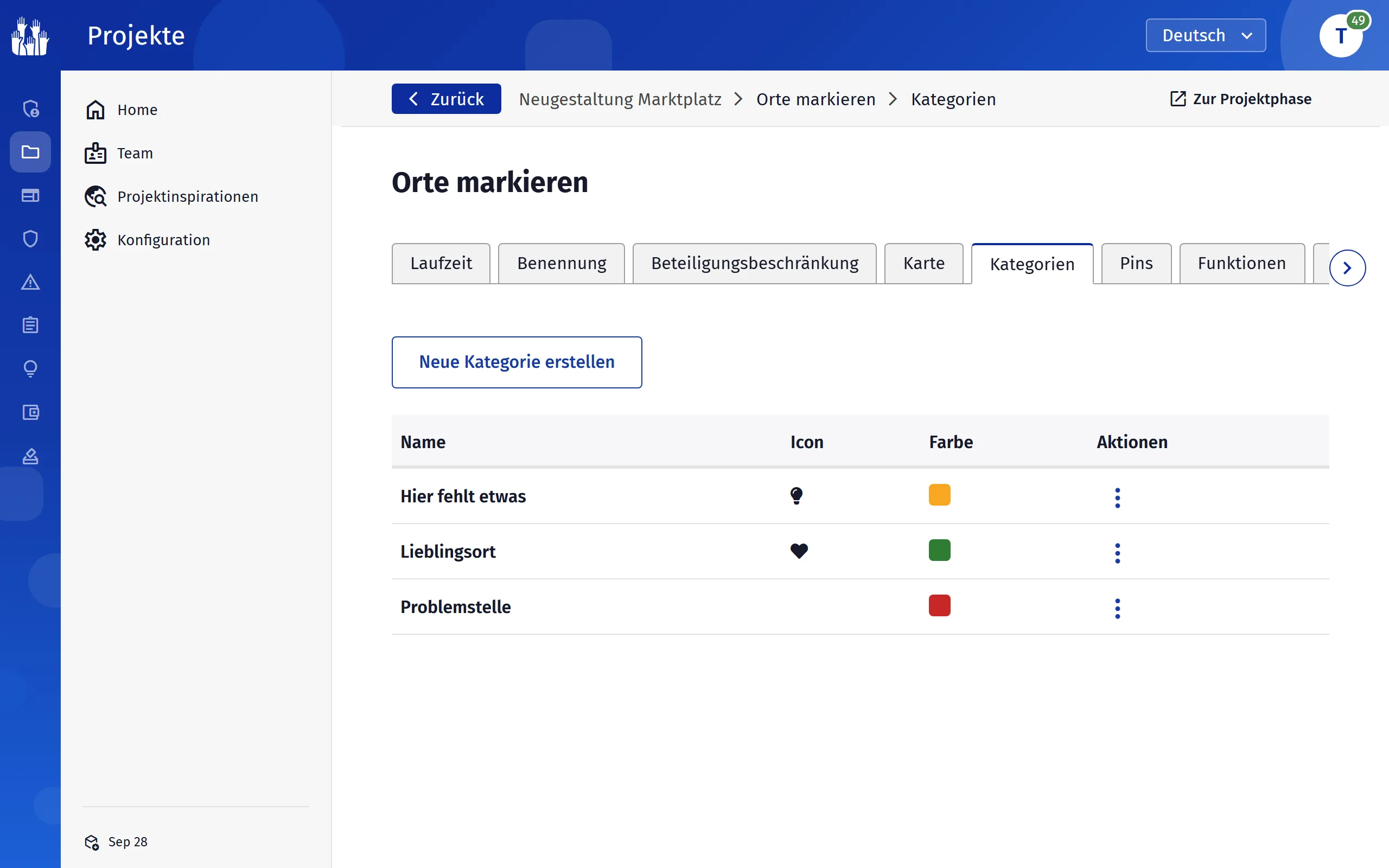
- In the “Categories” tab, click “Create new category” to set up the choices, each with “Name”, “Color” and “Icon”.
- Set “Duration” and “Participation restriction”.
- If needed, set a limit in the “Features” tab under “Maximum pins per user”.
- On the project page, place a test pin with “Add a new pin”, then delete it in the “Pins” tab.
The decisions
- Who can place pins?
- “Participation restriction” tab: by user status, area or age. If only the administration should enter places, turn off “Place pins” in the “Features” tab.
- How many pins per person?
- “Maximum pins per user” applies to the whole phase. Empty means no limit.
- Allow pins only in certain areas?
- Turn on “Only allow map entries inside marked areas” in the “Features” tab. Users can then place pins only inside the areas drawn in the phase’s “Map” tab. If no areas are drawn there, the map stays unrestricted.
- Import existing places?
- In the “Map” tab, “Import Masterportal data” imports places from a Masterportal or from GeoJSON files as pins. To learn how to prepare the files, see Integrate geodata
Evaluating results
- The “Map overview” tab shows all pins on one map.
- In the “Pins” tab, click “Download GeoJSON” to download all pins for a geographic information system.
Pitfalls
A pin consists only of a category and a location. Citizens can’t add text or comments to it.
You can’t delete a category that has pins assigned to it. So define the categories before you start.